How clothing shapes fantasy cultures: Designing a Magical Fantasy Cosplay to Deepen my Worldbuilding
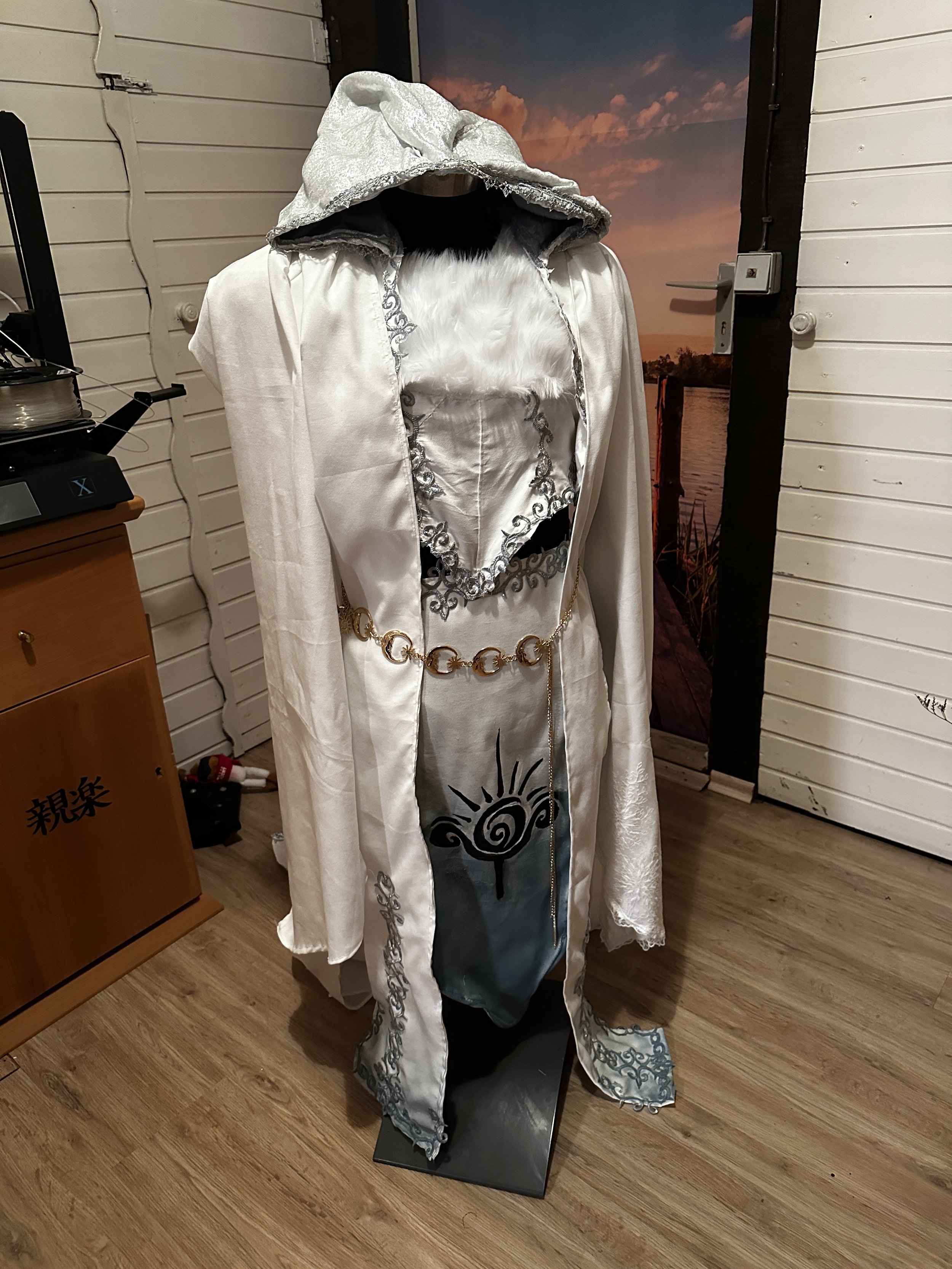


Another dream of mine has come true: I have always wanted to bring original designs from my world to life as cosplay. The robe of Eldwyn — one of the protagonists in the novel I’m currently writing — became the very first piece to step into reality.
The initial spark for the ornamental details came from Bakaneki Price, who helped ensure the design wouldn’t fade into plain white simplicity.
It was a real challenge.
For the life-threatening environment of Thal’draen, I intentionally wanted to avoid classic fur-heavy clothing like that seen in Avatar: The Last Airbender. Instead, the garments needed to express lightness and balance — while still providing warmth.
My first draft leaned further in that direction, but for Eldwyn — the daughter of the councilwoman — the design had to stand out.
Fortunately, Thal’draen is both technologically and magically advanced. I initially considered magical runes woven into the fabric to generate warmth. But ultimately, crystals became not only the solution to the warmth problem — they also evolved into a symbol of status.
Interestingly, while the first concept art provided direction, the actual design only truly emerged through experimenting with fabrics and intensive research.
In this post, I want to walk you through the creative process behind the robe — and of course, I’d love to hear your feedback.

Eldwyns Priester Uniform | Concept Art Design - Wyldheart Studio
Symbolism, Status, and Magic in the Design
Eldwyn’s uniform is a powerful symbol of spiritual authority and magical mastery within the Wyldheart Academy.
Unlike the robes of regular students, this garment stands out through refined materials, elevated elegance, and intricate magical embellishments.
The robe is crafted from high-quality, soft suede — chosen not just for its luxurious appearance, but for its natural warmth. The color palette transitions from pure white into frosted blue, symbolizing purity, knowledge, and connection to the Great Dragon Crystal at the heart of the capital.
Fine silver embroideries trace along the seams, forming arcane patterns reminiscent of ancient magical scripts. These are not purely decorative: they act as a subtle magical conductor, channeling warmth and energy throughout the garment.
Crystal shards — fragments of the Great Dragon Crystal — amplify this effect. They strengthen magical heat circulation and stabilize the energetic structure of the robe, making it feel like a living conduit of ancient magic.
Additionally, they enhance the wearer’s Tahl’ithara — their personal magical power.
Read all about the magicsystem here
Design Details and Cultural Meaning
A wide, elegantly falling cloak with a deep hood creates a mysterious silhouette. Fine threads run along the hood’s edge, ending in a crystal-shaped cut — symbolizing unity and connection under the belief that even in a vast universe, all beings remain spiritually linked.
The interior of the hood is lined with grey fur for warmth, while the exterior is covered in shimmering grey fabric designed to shield against magical interference.
A fur-lined collar with a blue crystal brooch completes the ensemble.
The robe differs significantly from the opulent garments of mentors and graduates, yet it clearly carries the spiritual signature of the academy. It was designed to be both functional and symbolic — representing purity, transformation, and devotion to the magical teachings of Thal’ithara.

Concept Art - first draft
Additional symbolic elements include:

Entwurf Sternenbrosche Wyldheart Academy - by Wyldheart Studio
Blauer Verlauf wurde mit Textilspray gemacht.
Das Symbol mit Acrylfarbe. | Logo Design by Lena Wieber
Silver lines crossing beneath a star brooch, representing shooting stars (guidance and aspiration)
Fur-trimmed shoulders for warmth and elegance
A ceremonial sash bearing the academy emblem:
The central spiral symbolizes lunar cycles
Radiating lines stand for order and control
Stylized wind currents represent intellectual ascension
Embroidered moon phases along the cloak hem, reflecting Thal’draen’s philosophy of life, death, and renewal
Snowflake embroidery woven with protective magic against frost and darkness
This robe is not just clothing — it is a companion on the wearer’s journey.

Material & Making
Step 1: Fabric and Material
The final design emerged not at my desk — but through physically experiencing materials.
I am not a professional tailor. At first, my knowledge of fabrics was limited. But I knew exactly what I wanted to feel: weight, warmth, and protection — something that matched Thal’draen’s harsh climate.
Fleece, cotton, and linen were too light. Too ordinary.
Then I discovered suede.
Used in double layers, it created the exact heaviness and insulation I imagined. It felt textured, structured, noble — like a fabric that carries history.
In total, I used nearly 10 meters of suede for the cloak base, sash, and upper garment.
Clothing, I realized, is more than design.
It is atmosphere, identity, and storytelling.
Fabric Link | Costs: 12,99.- / Yard
Step 2: The Pattern
Normally, I work by eye — using old shirts or jackets as rough guides.
But this time, I needed flexibility. I wanted the robe to fit multiple body types and potentially be worn by models.
After browsing Etsy, I found a suitable base pattern and adapted it to my vision. From there, I built the design step by step.
Pattern Link
Trust the Process
I stick everything together first, before sewing anything.
Am I the only one hating to sew sleeves?
Step 3: Trial & Error (Learning by Doing)
Improvisation became essential.
At one point, I had already sewn the hood onto the bolero when I decided to add grey fur lining for additional warmth. That meant unpicking everything — a process that required patience (and a fair amount of frustration).
The silver hood overlay caused similar chaos. Instead of undoing everything again, I improvised and reinforced it creatively.
Was it perfect? No.
Did it work? Yes.
Sometimes, design evolves through problem-solving rather than planning.
The cloak itself began as a loosely pinned experiment to test how the fabric would fall and interact with the rest of the outfit.
Improvisation truly became the key.

Details
After completing the base, I realized the robe still felt too plain for a protagonist.
I searched extensively for embroidery and ornamental appliqués. When I found the right snowflake patterns and crystal elements, everything clicked.
The breakthrough came again thanks to Bakaneki Price, who suggested cutting the ornamental band into smaller segments so the design would feel more delicate rather than overwhelming.
That single adjustment changed everything.
The sash emblem was created by printing the logo, cutting it out, securing it onto the fabric, and applying acrylic paint over textile spray.
Not everything turned out exactly as planned. Some lines meant to resemble shooting stars ended up giving the garment a subtle corset aesthetic instead. But combined with fur details and the blue crystal accents, the final look gained depth and elegance.
The crystals were hand-sewn individually.
The star brooch will later be crafted from foam clay by Bakaneki Price and may receive its own dedicated post.
Links for Details:
Ornaments | 11,19,-
Hood Details | 2,09.- / Stück
Crystals | 1,49.- / Stück
Textilspray Hellblau | 11,99.-
Snowflakes | 6,59.-
Moonbelt (optional): 3,14 .-
Among other things, I already had the fur and the fabric for the hood in my repertoire.
You can see that it was really just trial and error the whole time. No plan except for the choice of fabric.

What This Project Taught Me About Building a Fantasy World
This project was a mix of passion, improvisation, and genuine learning by doing.
I had no master plan. No professional tailoring skills. Just a vision.
Through fabric testing, failed seams, spontaneous design shifts, and countless hours of research, a robe emerged that not only looks like it belongs in Thal’draen — but feels like it does.
Heavy. Protective. Meaningful.
When building a fantasy world from scratch, sometimes the most powerful research method is physical creation. At least for me
It may not be perfect.
But it is real.
And sometimes, that is exactly what makes it magical & tangible.
Neuste Beiträge