What Is Ananthara?
Quicklinks
About | Ways to Enter | Future | Summary

Ananthara Map - Created by mothhawke / SirenSongBoutique on Etsy
A Fantasy World You Can Actually Step Into
There is a perfectly reasonable version of being a fantasy author where you write a book. Maybe several books.
You create a few characters, draw a map, spend an unreasonable amount of time wondering whether a river can geographically flow in that direction, and eventually send the whole thing out into the world.
Apparently, that was not enough for me. Somewhere along the way, “I am writing a fantasy story in my teens” turned into upcoming novels, artwork, interactive fiction, character creators, physical letters, collectibles, photography, lore archives, games, magical artefacts and approximately seventeen different ideas that all somehow belong to the same place.
So, welcome to Ananthara.
Ananthara is a living fantasy world built to be explored, experienced and, eventually, shaped by the people who enter it. It is a world of ancient gods, forgotten histories, strange cultures, magic, political conflicts, personal stories and mysteries that probably would have been much easier to manage if I had simply stopped worldbuilding about ten years ago. I did not. And now we are here.
How it all started

First ever (unpublished) Novels from around 2015
My love for fantasy started with The Lord of the Rings. I was fascinated by the idea that an entirely different world could exist somewhere beyond our own — with its own landscapes, languages, history, cultures and rules. A place you could disappear into for a while and, somehow, return from feeling a little different.
Over time, fantasy became more than escapism for me. It became a place where I could breathe.

Photo by Dean Recklies Photography
As a neurodivergent person, I know what it feels like to spend a lot of time adjusting yourself to the world around you. Watching how other people behave. Learning which parts of yourself are acceptable in a certain space. Becoming quieter, easier, less intense, less strange. Masking so well that, at some point, it becomes difficult to tell where the performance ends and you actually begin.
I have experienced what it means to suppress parts of yourself simply because being fully yourself does not always feel safe, welcome or understood. And I think that is one of the reasons I became so attached to fantasy in the first place. In those worlds, being different was often the interesting part. The strange character was not necessarily the one who needed to be fixed. Magic came from the things that made someone unique. Entire stories were built around people who refused to become what others expected them to be.
Ananthara slowly grew out of that longing.
I wanted to create a world you could enter without having to leave parts of yourself at the door. A world where you would not have to mask in order to belong. Where difference is not automatically something that needs to be corrected, hidden or made more convenient for everyone else. Where identity, self-expression and the search for your own place in the world are not side themes, but woven into its cultures, conflicts, characters, magic and history.
That does not mean Ananthara is some perfectly peaceful utopia where everyone holds hands and immediately understands one another. Quite the opposite. The world is full of oppression, rigid structures, prejudice, power struggles and people trying to decide who others are allowed to become.
Because freedom means very little in a story if nobody has ever tried to take it away.
What is the message of Ananthara?

Photo by Dean Recklies Photography
Many of Ananthara’s stories revolve around exactly that tension: the pressure to conform versus the courage to become yourself. Control versus freedom. The identities placed upon us versus the ones we choose. What happens when people are denied the right to express who they are — and what happens when they finally reclaim it.
Even the magic system grew from this idea.
In Ananthara, magic is not simply a power someone happens to possess. Thal’ithara is deeply connected to self-expression. It can emerge through the things that make a person who they are — their emotions, passions, memories, creativity and unique way of experiencing the world. For one person, it might manifest through painting. For another through music, writing, craftsmanship, nature or something entirely different.
Learning to control magic therefore also means learning to understand yourself. Suppressing it can have consequences. Losing your connection to yourself can have consequences too.
And becoming more powerful does not necessarily mean learning how to destroy increasingly large buildings with increasingly dramatic beams of light.
Although I am not ruling that out entirely. It means becoming more connected to who you actually are.
That idea became one of the foundations of Ananthara. Beneath the gods, ancient ruins, kingdoms, monsters and very questionable political decisions, it is a world about oppression, freedom, identity, belonging and self-expression.
But more than anything, I want Ananthara to feel like a place where you are allowed to arrive as yourself. Not a better version. Not a quieter version. Not the version you think will be easiest for everyone else to understand. Just you.
So… Is Ananthara a Book?

Photo by Dean Recklies Photography | Book by Bakaneki_Price
Yes. Also no. Extremely helpful, I know.
There are novels being developed inside Ananthara, and they form an important part of its larger story. But somewhere along the way I realized that I did not only want people to read about this world. I wanted there to be different ways of entering it.
Some people want to sit down with a novel and disappear for six hours. Others want to uncover obscure pieces of lore that absolutely nobody asked them to memorize but that they will now explain to their friends at dinner. Some want to create their own character. Some want to make decisions and discover what happens because of them. Others want artwork, letters, artefacts and physical objects that make a fictional place feel strangely tangible. And some apparently want to dress as an adventurer, walk into a forest and have cinematic photographs taken of their own fantasy character (me included).
Luckily, I happen to enjoy making all of those things.
That is why Ananthara is slowly becoming less like one single story and more like an immersive fantasy universe. The novels tell stories within it. The artwork reveals pieces of it. The lore expands it. Interactive fiction allows you to explore it. Physical letters and collectibles let fragments of the world exist outside a screen. Fantasy photography brings characters into reality. And over time, more of these experiences will give you the opportunity to become part of the world yourself.
Let me show you some examples
Making a Fictional World Feel Real
One of my favorite parts of building Ananthara is finding ways to make a place that does not technically exist feel just a little more tangible.
That is also how projects such as the Fantasy Snail Mail Club came into existence. Instead of only reading that a distant kingdom exists, you might receive a physical letter from someone travelling through it, accompanied by artwork, field notes, fragments of history, collectibles or clues.

The current journey follows Wyld as he travels through the different regions of Ananthara while trying to understand a mysterious magical book and the missing pieces of his own past. Through his letters, places such as Bay’r, V’eild and Thal’draen are not simply pages in an encyclopedia. They become places he has walked through, people he has met, festivals he has witnessed and mysteries he still does not fully understand.
What If Your Character
Could Live Here Too?
Eventually, I do not want your relationship with Ananthara to stop at: “Here are my characters. Please observe them.”
I especially want there to be room for yours.
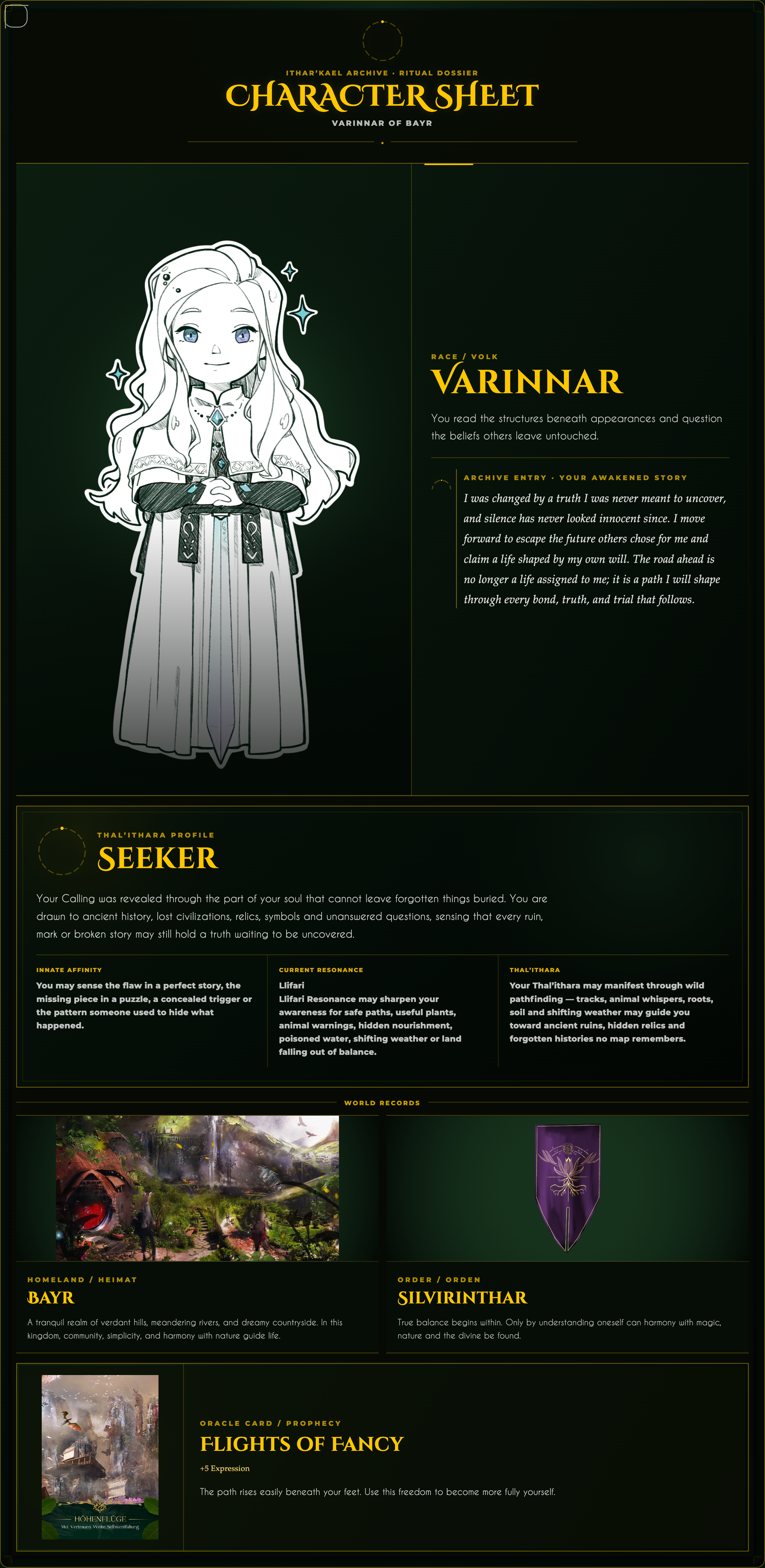
The Character Creator, interactive fiction, fantasy photography and future projects all move toward the same question: Who would you be in this world?
Where would you come from?
What would you believe?
What kind of magic would answer to you?
What would you protect?
Which path would you choose?
What would you become if your story began somewhere completely different?
Fantasy becomes incredibly powerful when it gives us permission to imagine ourselves differently.
That does not mean everyone needs to become the chosen hero of an enormous canonical storyline. Quite frankly, having eight hundred protagonists simultaneously trying to save the universe sounds like an administrative nightmare. But I want Ananthara to feel large enough that there could be space for your story too.
That is also where projects like fantasy character photography come in. Instead of only imagining a character, you can create them, step into their role and bring a piece of that fictional identity into the real world. In the future, interactive stories and games can take that even further.
And if you are the kind of person who eventually desperately needs to know the religious significance of a random carving mentioned in paragraph four of a letter from six months ago?
Excellent. I have been waiting for you.
Ananthara Is Still Being Built

Model: Mary_Misantrophe
Perhaps one of the most important things to understand about Ananthara is that it is not a finished franchise that appeared fully formed with forty novels, three video games, a television adaptation and an aggressively organized merchandise department. (Although that list would cover everything i’d want for Ananthara)
It is being built right now.
The novels are growing. The lore is growing. The interactive fiction is growing. New artwork, stories, artefacts, experiences and pieces of the world are constantly being created and connected to one another.
But I also think there is something special about discovering a world while it is still being created. You are not arriving after every answer has already been written and every door has been locked into place. You get to watch those doors appear. You get to see sketches become kingdoms, pieces of lore become artefacts, characters become photographs and old ideas transform into entirely new projects.
In a way, building Ananthara is part of Ananthara itself.
Summary: So, What is Ananthara?
The shortest answer is probably this: Ananthara is a fantasy world you can step into.
It begins with stories, but it does not have to end there. You can read its novels, explore its lore, play through its stories, create a character, receive pieces of the world through the mail, collect its artwork and artefacts, bring a fantasy character to life or simply follow along while one person continues making increasingly questionable decisions about how many creative mediums a single fantasy project really needs.
The bigger dream behind all of it
is surprisingly simple.
I want to create the kind of fantasy world I always wanted to discover myself. One you can escape into. One that rewards curiosity. One filled with mysteries, characters and places worth uncovering. A world that does not only ask you to watch someone else's adventure from a distance, but occasionally lets you reach through the page and touch a piece of it yourself.
And maybe, after wandering through it for a while, you will eventually look around and think:


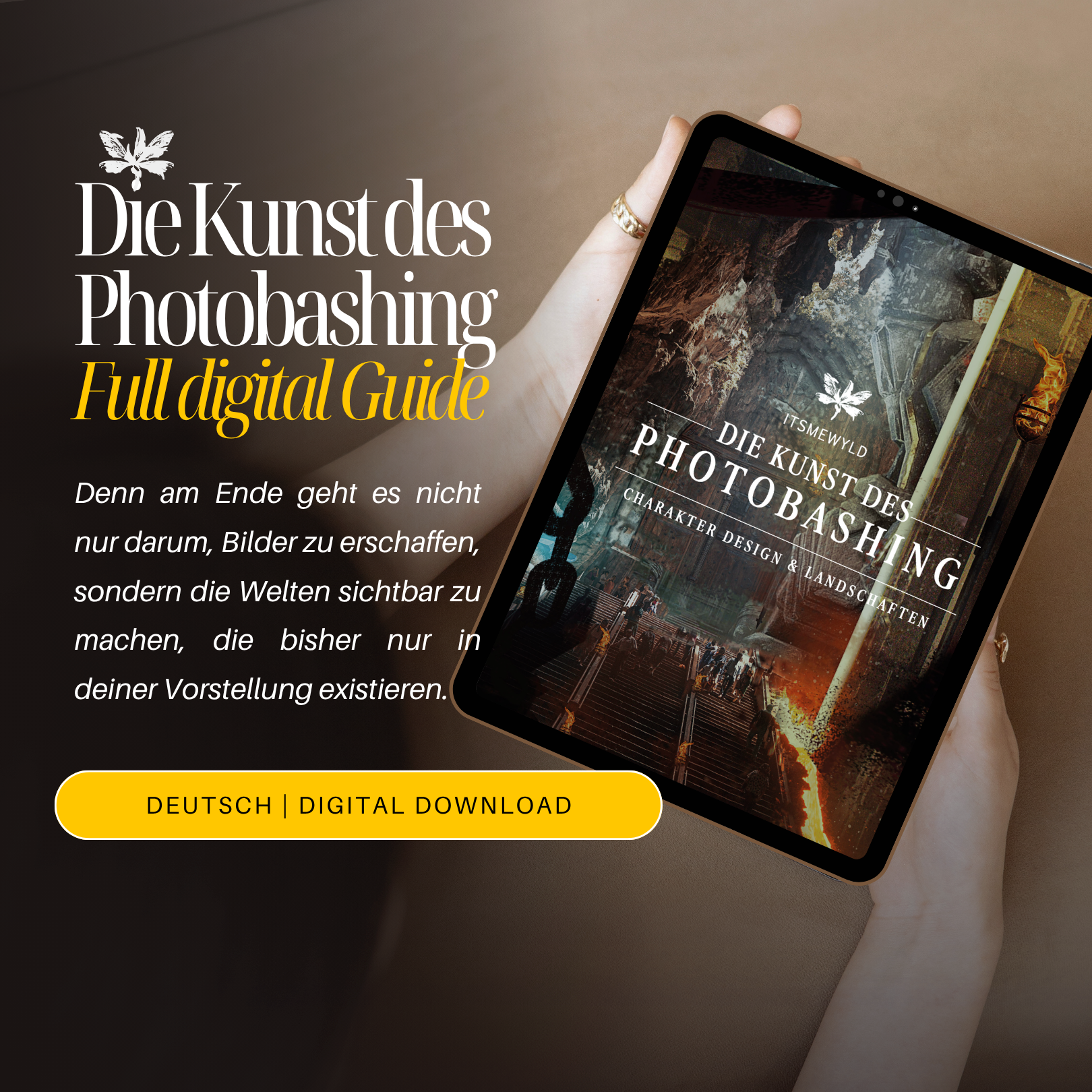
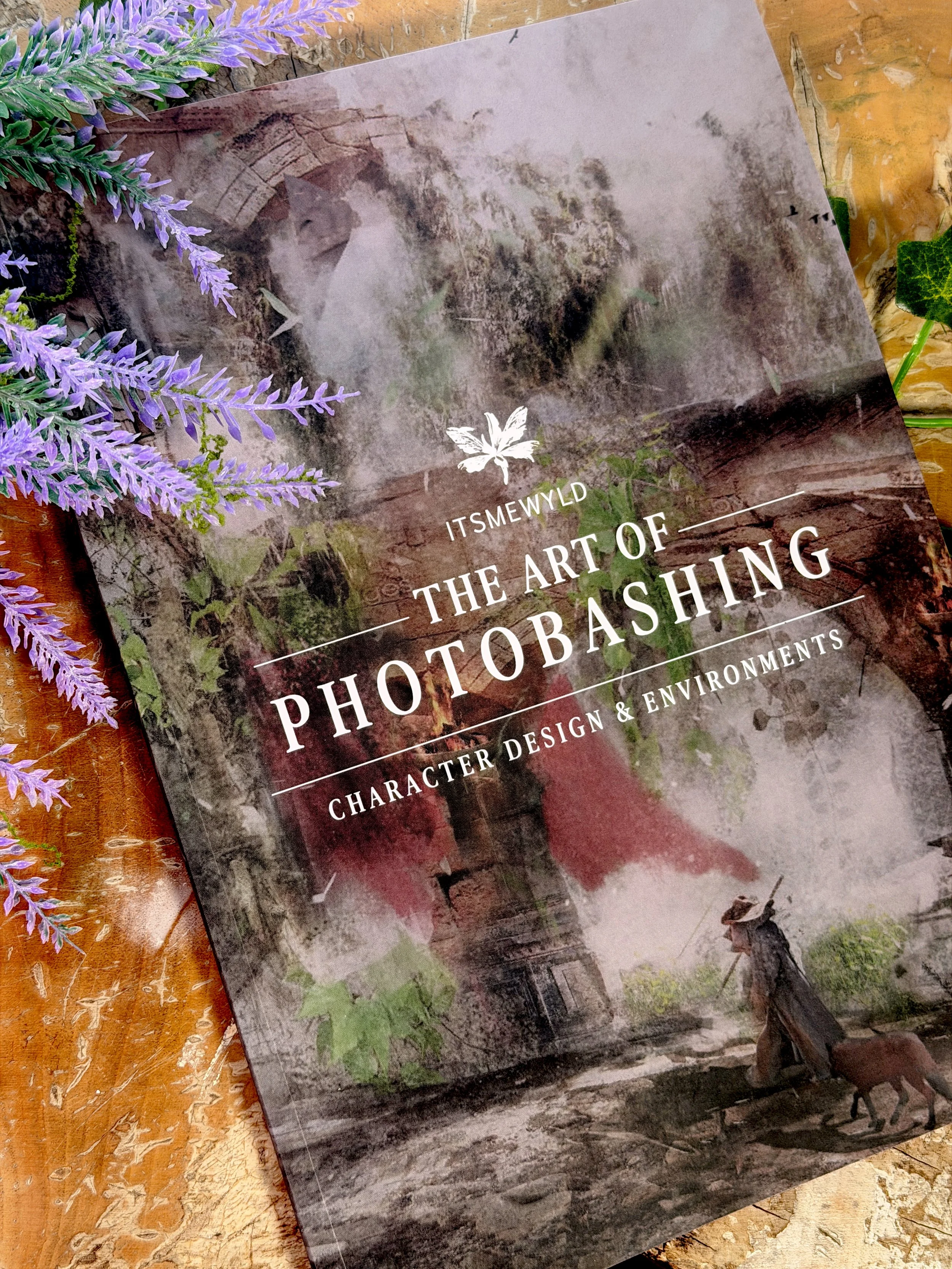
Learn how to turn your ideas into artworks through Photobashing Techniques by combining photography, 3D, and digital painting into characters, environments, and cinematic fantasy scenes. In this 164 Pages Full step-by-step photobashing guide, we explore important artistic fundamentals and learn how to combine photography, your own references, 3D scenes, digital painting, and photobashing techniques into cohesive finished artwork, for artists who want to create atmospheric characters, cinematic scenes, and immersive fantasy worlds.
Inside the guide you will learn about:
Photobashing techniques and workflow
Character design and visual development
Environment and landscape design
Creating your own photo references
Working with 3D scenes and references
Composition, lighting, Color Grading, and Storytelling
Fundamental Workflow for Photoshop, Blender and Procreate
Language: English
Format: Full Digital Guide / PDF
Delivery: Instant Digital Download